
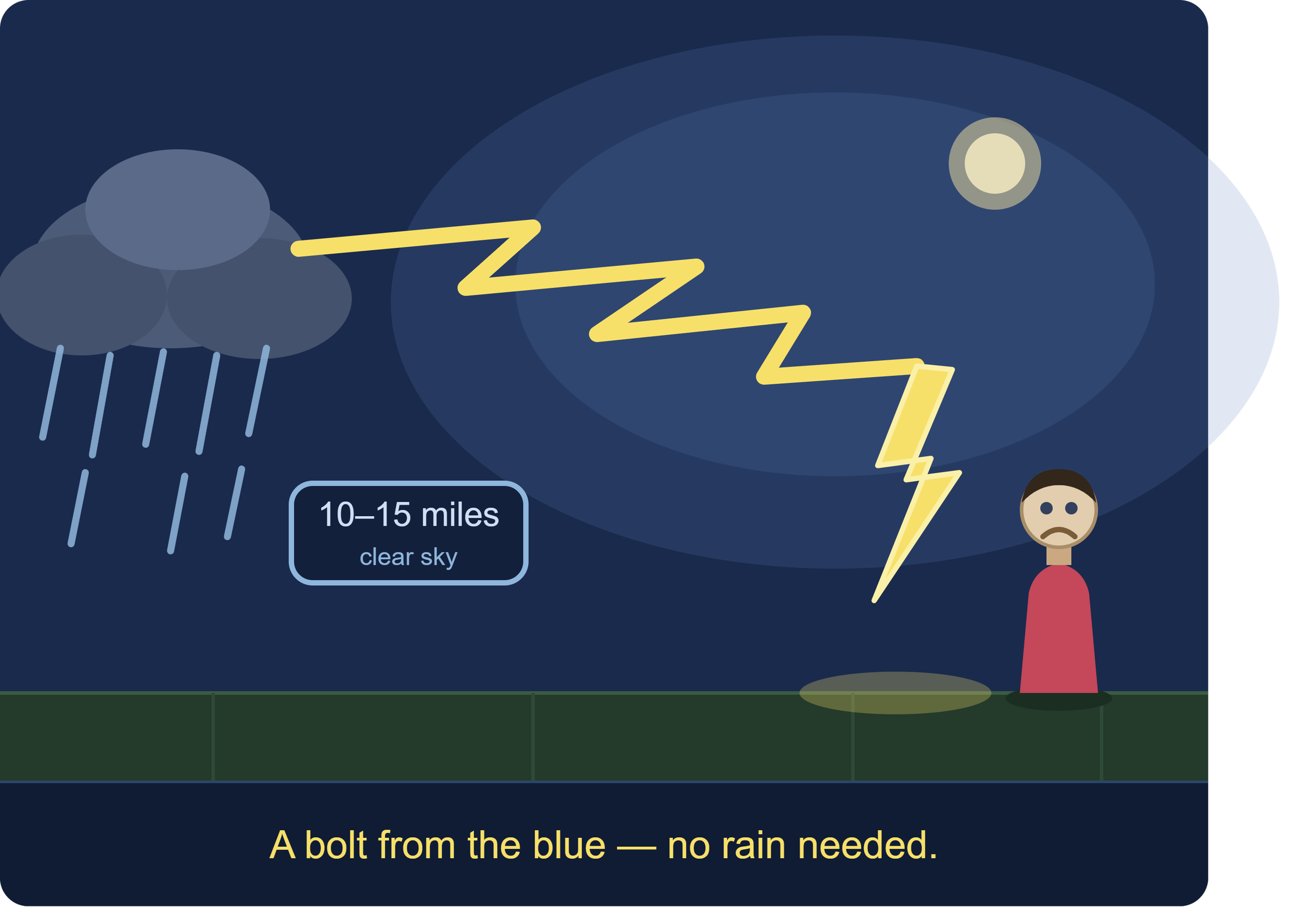
You were commanded by your parents to look after your little brother while they part their ways for work. You decide to walk your brother to the park. As you push on the swing, you hear a loud thump! You go and take shelter thinking that rain is going to fall. Now you really think and wonder why rain is not coming. You think it is your brother’s fart but you would never know since he is only two. You realize it is definitely a lightning strike since the sky went all bright when the sound erupted through the air. You then wonder, does lightning strike even when it is not raining? Let’s pop this balloon to find out!
What is lightning?
Lightning is a giant electrical spark that forms with opposite charges. Lightning comes in five steps. First the particles in a cloud rub together, like rubbing a balloon on your head. Since the particles are rubbing against each other they form charges. Lighter particles are normally positive charges, whereas heavier particles are negative charges, which sinks to the bottom. Then, the cloud that holds these charges becomes a giant battery in the sky, with positive charges in the top and heavier charges in the bottom. After that the negative charges repel the electrons below making the ground to build a positive charge that reaches to the clouds. Then, when the resistance of the charges gets too big the air (conductor) can't hold it any more causing the charges to break through to create lightning.
Does lightning strike even when it is not raining?
This myth is true. Lightning does strike even when it is not raining. Lightning often strikes more than three miles from the center of a thunderstorm, well outside the rain or even the cloud. The bolt leaves the top or side of the storm, travels sideways through the anvil, and comes down somewhere nobody thinks is in danger. That is what makes it dangerous since nothing around you suggests a threat.
Fun Facts
A bolt heats the air to around 30,000°C which is several times hotter than the Sun’s surface. That’s one of the rare myths on your list that’s actually true. Thunder is that heated air exploding outward. The flash and the bang happen together; light just gets to you faster. Count the seconds between flash and thunder and divide by five for miles, or three for kilometers.