
You are out at the park with some friends to eat ice cream. You have the Neapolitan ice cream with chocolate sauce and sprinkles. As you walk on the rough sidewalk next to the green monkey bars and slides, ice cream drips on your hand. As you walk the unnoticed ice cream juice gets sticky on your hand. That attracts a bee as it sits on your elbow. You then see the bee resting, about to puncture their stinger into your skin. You sway it way, as you run far from your friends.
"Thank god, since you swayed it way, the bee won't sting you and die," your friend sighs with relief.
You then were sad that ice cream went to waste, but then you wonder, do bees die after they sting you? Let’s pop the balloon to find out!
What is a bee?
Bees are winged insects part of the super family Apoidea that are omnivorous. They are closely related to wasps and ants, and there are more than 20,000 known species worldwide. Most people picture honeybees when they hear the word bee, but that is only one of them, and it is unusual in several ways. The vast majority of bee species are solitary — a single female builds her own nest, lays her eggs, and never meets a queen or a hive. Only a small fraction, including honeybees and bumblebees, live in colonies with a queen, workers, and a shared nest. Bees feed on nectar for energy and pollen for protein, and while they are gathering it, pollen sticks to their bodies and gets carried from flower to flower, which is how they pollinate plants. That makes bees one of the most important and needed pollinators for both wild plants and food crops. Their bodies, with hair that traps pollen and on most species, a patch of stiff hairs on the back legs for carrying it, makes them built for the job. Males can't sting at all, since female bees have a stinger which is a modified egg-laying organ. Bees see ultraviolet light that humans cannot, so many flowers carry patterns invisible to us that guide bees to the nectar.
Do bees die after they sting you?
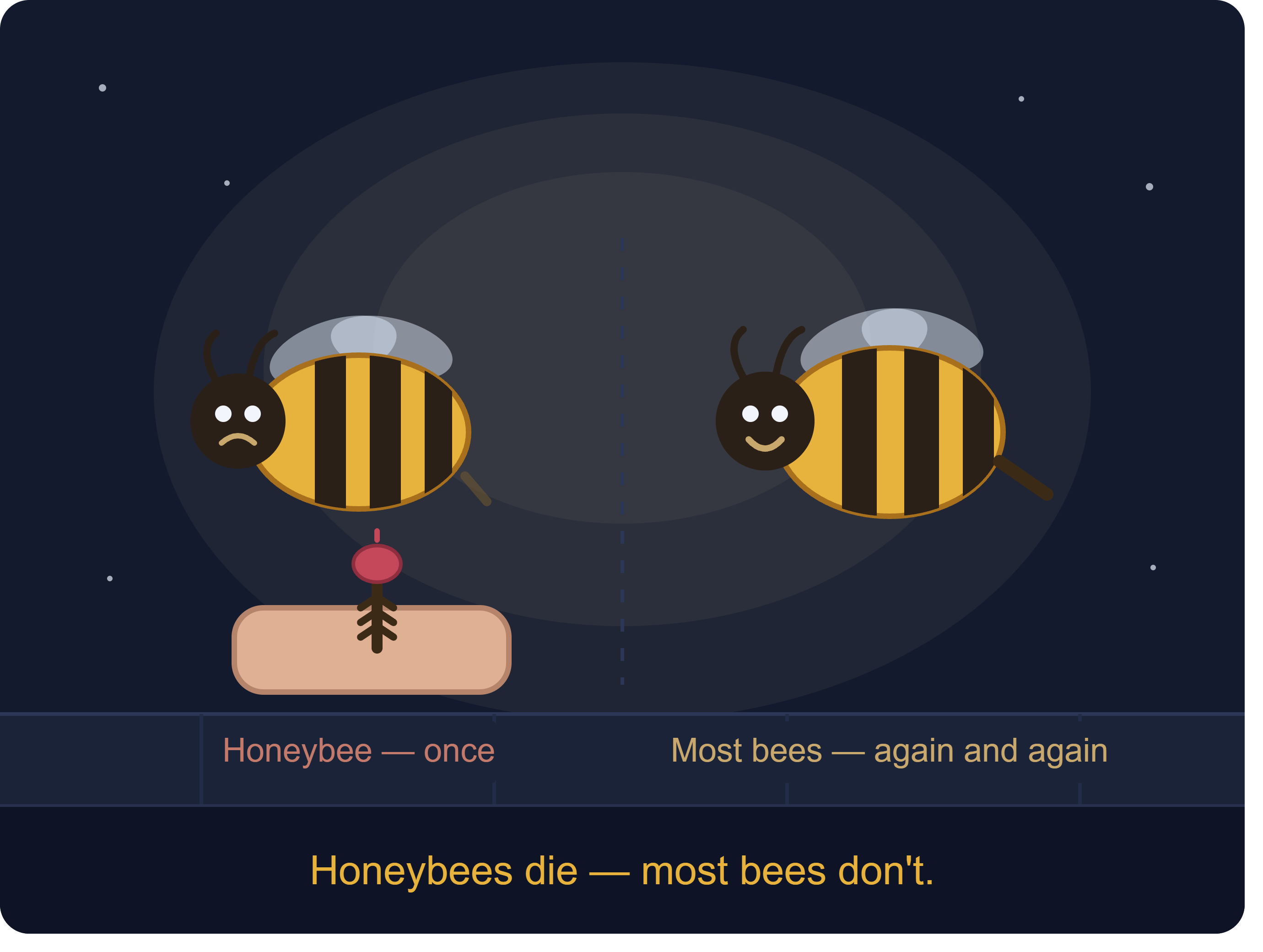
This myth is half-true. The honey bee really do die after they sting you. The stinger on a honey bee is jagged, so when the honey bee stings you it pierces the skin of a mammal (which is thick) and get lodged and stuck in the skin. Yet, a honeybee doesn’t always die. Sting another insect, with a thin exoskeleton rather than stretchy mammal skin, and it can usually pull the stinger back out and survive. The spikes normally get stuck in us mammals. That injury kills the bee, yet the venom sac in the stinger keeps pumping venom, since it has its own muscles. Although most bees have smooth stingers and can sting repeatedly. In fact, only eight out of 22,000 bee species in the world die when they sting. Some bees include bumblebees, carpenter bees, mason bees, etc.
Fun Facts
There’s a color called “bee’s purple” — a mix of ultraviolet and yellow that we can’t see at all. If the queen dies, the workers make a new one by picking a young larva and feeding it royal jelly until it develops into a fertile queen. Honeybees produce two to three times more honey than they need, which is the only reason we get any.